
 Pythie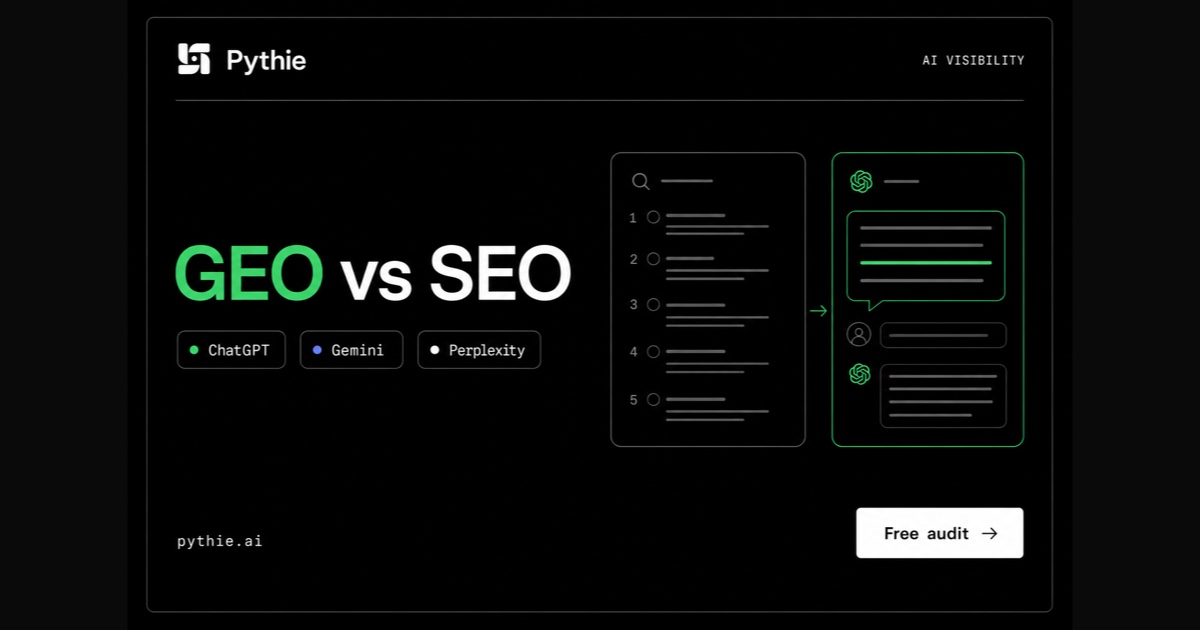
GEO vs SEO: The Real Difference, and Why You Need Both
SEO targets Google's results page; GEO targets the answer ChatGPT, Gemini or Perplexity writes. Definitions, five concrete differences, and a way to measure.
The short version:
- SEO optimizes your site to rank on a results page; GEO optimizes your presence to be mentioned and cited in the answer ChatGPT, Gemini or Perplexity writes.
- GEO stands for Generative Engine Optimization, a term coined by a Princeton and IIT Delhi study (Aggarwal et al., KDD 2024) that measured visibility gains of up to 40% with the right tactics.
- The foundations are shared (content that answers, a readable site, third-party authority): good SEO is the base of GEO, not its rival.
- What really changes: the unit you optimize (the passage, not the page), the metric (the mention, not the position) and the variability of the answers.
- To see where you stand on the GEO side, the free audit measures in one minute whether the three engines mention your brand on 10 questions from your market.
What is GEO?
GEO (Generative Engine Optimization) is the set of practices that increase the probability that your brand gets mentioned, recommended or cited as a source when an AI engine writes its answer. Where SEO works on your rank in a list of links, GEO works on your place inside a written text.
The term comes from academia: the Princeton and IIT Delhi study (Aggarwal et al., presented at KDD 2024) defined it and tested nine optimization tactics on a 10,000-query benchmark. The result: citing sources, adding statistics and attributed quotes can boost a site’s visibility by up to 40% in generative engine responses. GEO is not a slogan: it is a measured practice, with tactics that work and tactics that don’t.
You will run into synonyms: AEO (Answer Engine Optimization), LLMO (Large Language Model Optimization), or simply AI SEO. The vocabulary varies, the practice is the same; we come back to it below.
SEO and GEO: what stays the same
The foundations are identical, because generative engines read the web that SEO taught you to work on. Content that precisely answers a question, a site robots can read, and third parties talking about you: those three pillars serve both disciplines.
The continuity is direct: when ChatGPT or Perplexity turns on web search, it relies on an index of pages, selects sources, then writes. A page that ranks well in SEO is more likely to be read, therefore cited. Seer Interactive measured it on about 10,000 finance and SaaS queries: the correlation between ranking on Google’s first page and brand mentions in LLM answers reaches about 0.65, while the weight of backlinks comes out weak to neutral. And third parties count double: our analysis of the sources AI engines cite shows each engine has its own ecosystem (Wikipedia carries 47.9% of ChatGPT’s top-10 citations, Reddit 46.7% of Perplexity’s) and that these ecosystems barely overlap.
In other words: if your SEO is nonexistent, start there. GEO does not rescue an invisible site.
The five differences that matter
The shift fits in one sentence: SEO optimizes a page for a ranking, GEO optimizes a presence for a written answer. Concretely, five things change:
| SEO | GEO | |
|---|---|---|
| The target outcome | A link ranked on a results page | A mention or citation inside a written answer |
| The unit you optimize | The page | The passage: the 50-to-150-word block the engine extracts |
| The core metric | Position and clicks | Mention rate and share of voice |
| Stability | Relatively stable rankings | Answers that vary run to run and engine to engine |
| Measurement tooling | Search Console, free and official | No official equivalent: manual protocol or dedicated tool |
Two of these differences weigh more than the others. The unit first: generative engines extract passages, not pages; a direct 50-word answer at the top of a section beats a 2,000-word argument with no entry point. Measurement second: with no Search Console for AI engines, you don’t know whether you are progressing until you set up your own measurement, manual or tooled.
And the overlap between the two games is smaller than you would think: according to Ahrefs’ August 2025 study of 15,000 queries, only 12% of the URLs AI assistants cite as sources appear in Google’s top 10 for the same query (28.6% for Perplexity, 8% for ChatGPT). Ranking well helps; ranking well is not enough.
GEO, AEO, LLMO: sorting out the vocabulary
All these acronyms describe the same practice, seen by different communities. GEO is the academic and most common term; AEO (Answer Engine Optimization) stresses the "answer engines"; LLMO puts the accent on the models themselves. You will also see AI SEO, or ChatGPT SEO for the most used engine.
The only vocabulary trap is believing these are separate disciplines to stack. If an agency sells you GEO, AEO and LLMO as three invoice lines, that is three times the same thing.
Do you have to choose between SEO and GEO?
No, and 2026 settled that debate with numbers, in both directions. Gartner predicted in February 2024 a 25% drop in traditional search engine volume by 2026: the drop did not happen. Semrush’s April 2026 study of more than 50,000 sites measured AI-referred traffic growing 66% over 2025, yet still representing less than 0.15% of total traffic. SEO massively dominates the volume; AI answers concentrate the growth, without replacing it.
The value per visitor leans the other way: according to Semrush’s July 2025 study, a visitor coming from AI search is worth on average 4.4 times a visitor from classic organic search, based on conversion rate. And the recommendation increasingly forms before any click: the Pew Research Center measured that when an AI summary appears on Google, the click rate on classic results falls from 15% to 8%.
So the right reading is not "GEO replaces SEO" but "SEO secures today’s volume, GEO secures tomorrow’s recommendation". The two share the same base; the difference plays out in measurement and in a few specific tactics.
How do you measure GEO results?
Three metrics are enough to steer: the mention rate (the share of answers where your brand appears), the position of the mention (first recommendation or eighth), and the share of voice against your competitors. All of it engine by engine: the gaps between ChatGPT, Gemini and Perplexity are often spectacular.
You can measure by hand: 10 to 15 buyer questions without brand names, several runs per question, each engine separately. Plan one to two hours per measurement. Or start from a snapshot: the free audit asks the three engines 10 questions from your market and shows your mentions, your competitors and the cited sources, in one minute, no account needed.
Frequently asked questions
How long before GEO shows results?
Think in weeks, not days. Engines re-crawl their sources and re-weight their indexes continuously: an answer page published today can be cited a few weeks later. That is the pace behind our 30-day ChatGPT plan: initial measurement, actions, re-measurement at day 30, engine by engine.
Does GEO work for a small brand?
Yes, often better than SEO does. Generative engines readily cite niche sources: specialized directories, independent comparisons, industry discussion threads. A small brand well established in its market’s source ecosystem can get recommended next to much bigger players, where Google’s first page remains out of reach.
Can you pay to appear in AI engine answers?
No: to date, neither OpenAI, nor Google, nor Perplexity sells brand placement inside the organic answers of their assistants. Visibility there is earned through the sources the engines read. That is precisely what makes GEO measurable and workable: the levers are editorial, not paid.