
 Pythie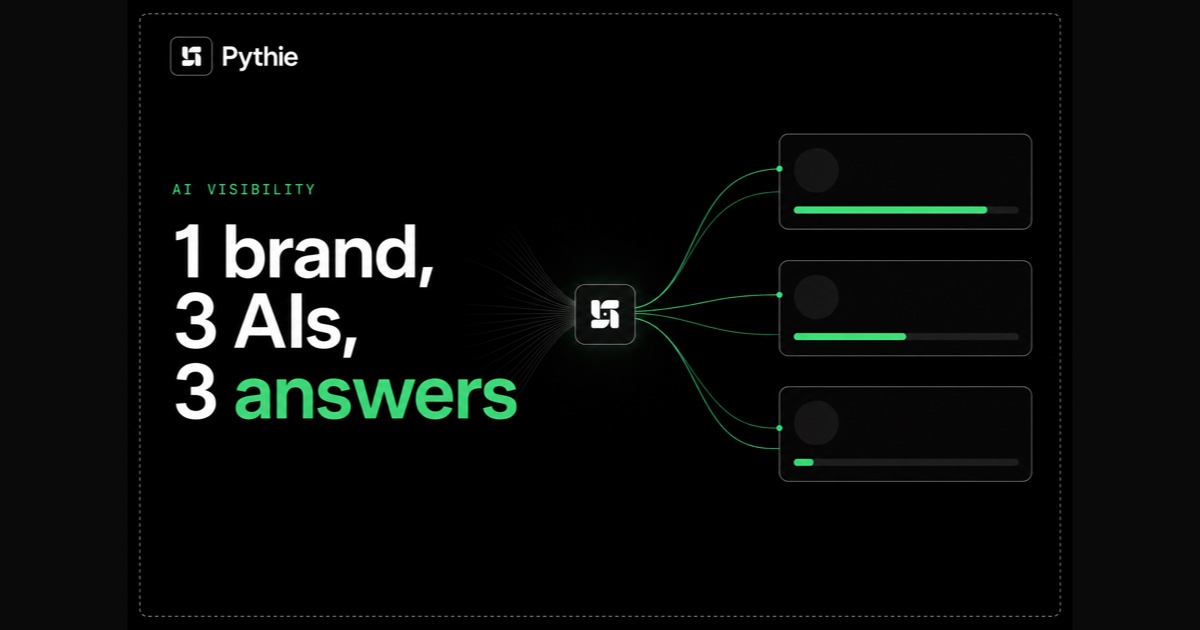
Why ChatGPT, Gemini and Perplexity Disagree About Your Brand
AI visibility is not one number: the same brand measured 100% visible on Gemini and 30% on ChatGPT. Real audit data, why engines diverge, and how to check yours.
The short version:
- AI visibility is how often answer engines like ChatGPT, Gemini and Perplexity mention your brand when buyers ask questions about your market.
- It is not one number: in June 2026 we measured the same brand at 100% visibility on Gemini and 30% on ChatGPT.
- The engines barely overlap: only 11% of domains cited by ChatGPT are also cited by Perplexity, across 680 million citations analyzed by Averi.
- You can check yours manually with 10 questions, or in one minute with Pythie’s free audit.
What is AI visibility?
AI visibility is the share of answers in which ChatGPT, Gemini or Perplexity mention your brand when asked the questions your buyers actually ask. It is becoming the front line of search: Capgemini found that 58% of consumers now turn to generative AI instead of search engines for product and service recommendations, and Pew Research measured that when an AI summary appears on Google, clicks to websites drop from 15% to 8%. The decision forms inside the answer, before any click.
Two concepts often get mixed up, and the difference matters:
- a mention: your brand is named in the answer, which is what buyers read;
- a citation: your site is listed as a source for the answer, which is what drives traffic.
A brand can be mentioned without ever being cited as a source, and the other way around. Both can be measured.
One brand, three engines, three different answers
In June 2026 we audited Pennylane, a French finance software company, with Pythie’s method: 10 questions in the buyer’s language that a prospect would really ask, never naming the brand, sent to the official APIs of 3 engines with web search enabled, for 30 answers analyzed.
Same brand, same day:
- Gemini: 100% visibility (mentioned in 10 answers out of 10)
- Perplexity: 60%
- ChatGPT: 30%, recommending QuickBooks and FreshBooks instead
A founder testing the brand only in ChatGPT would conclude it is invisible. Another looking only at Gemini would feel untouchable. Both would be wrong: AI visibility has to be measured engine by engine.
Why the engines don’t agree
These gaps are not measurement noise. They come from how each engine reads the web.
Each engine has its own sources. The Yext study from October 2025, based on 6.8 million citations, found that Gemini pulls the majority of its citations from brand-owned websites, while ChatGPT leans first on third-party sites, and Perplexity favors niche directories. Averi’s 2026 benchmark across 680 million citations found that only 11% of domains cited by ChatGPT are also cited by Perplexity, a figure independently corroborated by Whitehat SEO on 118,000 responses.
Different signals move different engines. Ahrefs correlated the visibility of 75,000 brands and found YouTube mentions to be the strongest single correlate of AI visibility (0.74), while classic domain authority barely matters for ChatGPT (0.27). What earned you your Google rankings is not automatically what earns you mentions in answers.
Memory or live search. Engines answer from the model’s memory a large share of the time. If the model doesn’t know your brand, you don’t exist in those answers, however good your website is today.
The practical consequence: optimizing “for AI” as a block makes no sense. You need to know which engine ignores you, and where that engine gets its information.
Why doesn’t ChatGPT recommend my brand?
Three causes cover most cases: the model doesn’t know you (your brand is absent from its memory and web search isn’t always triggered), the sources it consults don’t talk about you (comparison sites, forums, directories), or your competitors are simply better established there. None of these can be fixed before being measured: the fix for a memory gap (durable third-party mentions) is not the fix for a sources gap (being present where the engine reads).
How to check if ChatGPT mentions your brand
The manual protocol, reproducible:
- List 10 questions your buyers actually ask, without naming your brand (“best payroll software for a small business?”, not “is MyBrand good?”).
- Ask them in fresh conversations, web search enabled, logged out of your history.
- Repeat each question several times: answers vary from run to run.
- For each answer, note whether your brand is mentioned, in which position, and who is named instead.
- Do it again on Gemini and Perplexity. Then do it all again every week.
That is dozens of answers to read for one honest measurement. The free audit automates exactly this: 10 questions, 3 engines, a score per engine, the real answer excerpts and the sources each engine used, in one minute, no account needed.
Why “Pythie”?
In ancient Greece, people crossed the country to ask the Pythia of Delphi one question, and left with an answer nobody argued with. Asking ChatGPT is consulting the modern oracle: one question, one confident answer, taken at face value.
The difference is that there are now several temples, and their oracles disagree. Pythie exists for one reason: to know what each oracle says about your market, and why. Measure first, optimize second.
The audit is free, and the founder subscription is open for weekly tracking, at a price locked for life for the first subscribers.
Frequently asked questions
Do ChatGPT, Gemini and Perplexity give the same answers about brands?
No. Their citation sources barely overlap (11% of domains in common between ChatGPT and Perplexity according to Averi) and their source mix differs by design: brand-owned sites for Gemini, third-party sites for ChatGPT, niche directories for Perplexity. Measuring one engine tells you almost nothing about the others.
Is AI visibility just SEO?
It overlaps but diverges. The practice is often called GEO (Generative Engine Optimization) or AEO (Answer Engine Optimization): unlike classic SEO, it is about being mentioned inside answers (with or without a link), it depends on the model’s memory as much as on the live web, and it weighs sources like forums, comparisons and YouTube differently. Strong rankings do not guarantee mentions.
How often does AI visibility change?
Constantly. Answers vary from run to run and models are updated continuously: a one-off check is a snapshot, not a climate. That is why Pythie repeats every question several times per measurement and tracks scores weekly.